Building the Path Forward: How advocacy helped secure five more years of America's Seed Fund.
The reauthorization of SBIR and STTR through FY2031 secures a critical source of funding for innovators tackling some of healthcare's most urgent challenges. Learn how advocacy efforts across the medtech community helped keep America's Seed Fund moving forward—and why it matters for companies like Armor Medical.
COMMUNITY & EVENTS
4/17/20262 min read
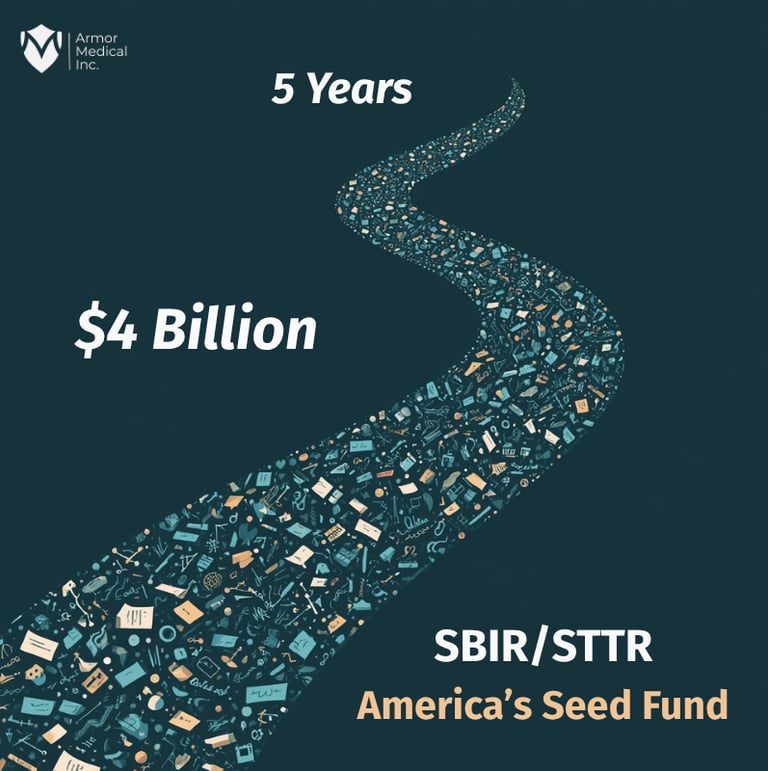
On April 13, 2026, Small Business Innovation and Economic Security Act was signed into law, officially reauthorizing the SBIR and STTR programs through fiscal year 2031. This legislation is fundamental to our nation’s innovation engine. Armor Medical may not exist today, were it not for the support of this program. We are deeply grateful to all those who helped get this done.
SBIR and STTR are often called America's Seed Fund. Every year, these programs distribute more than four billion dollars in federal research and development funding directly to small businesses, roughly 4,000 companies annually, working on innovations with real commercial and societal potential. For early-stage medical device companies like us, this kind of funding fills a gap that venture capital rarely touches. It’s a bridge across the valley of death.
When the programs' authorization expired on September 30, 2025, new awards went on pause. Solicitations stopped. Companies at critical moments in their development were left in a six-month holding pattern with no clear timeline. The consequences were real — delayed hiring, shifted research schedules, and meaningful setbacks for teams working on urgent problems.
Getting to reauthorization required months of organized, sustained advocacy. We are proud members of AdvaMed, whose more than 600 member companies span the full medtech ecosystem. Nearly 90 percent of AdvaMed's Accel members have applied for SBIR or STTR funding, so the stakes were felt across the entire community. Through the AdvaMed Working Group, advocates coordinated tirelessly to push this legislation across the finish line, writing letters to local representatives, engaging lawmakers directly, and keeping the pressure consistent.
A heartfelt thank you to Liz Powell, Esq., MPH and G2G Consulting for leading that effort with clarity and persistence, and for keeping every stakeholder informed at every step. This kind of dedicated, long-view advocacy is what actually moves legislation.
The bill that passed is the longest authorization window in recent SBIR and STTR history, five years, and it includes meaningful updates: stronger security provisions, expanded technical assistance, and new commercialization support.
For Armor Medical, this is personal. We are building a wearable device to monitor postpartum hemorrhage in real time, for women who cannot afford innovation delays. Federal programs that fund early-stage research are not just good for business. They are part of what makes it possible to solve problems that the market alone would not prioritize quickly enough.
We are grateful to everyone who made this happen. Now we get back to work.
Wearable Innovation to Safeguard Maternal Health

Recognized by
© 2026 Armor Medical Inc. All rights reserved.